Thinking about trading your Midlothian subdivision lot for open space in Powhatan? It sounds simple on paper, but the day-to-day reality can feel very different once you move from a neighborhood setting to a larger parcel. If you are considering that shift, this guide will help you understand what changes, what to plan for, and what questions to ask before you buy. Let’s dive in.
Why buyers make the move
For many buyers, the appeal of Powhatan starts with space. Powhatan County remains a low-density market with about 32,392 residents spread across 260.2 square miles, which works out to roughly 116.6 people per square mile. That lower-density feel is a major contrast from a more typical suburban subdivision pattern.
The county’s long-range plan also makes its priorities clear. Powhatan aims to preserve rural character, including privacy, quiet, natural habitats, forested land, rivers and streams, dark skies, and uncrowded conditions. If those features matter to you, Powhatan may offer the kind of lifestyle shift you are looking for.
What “more land” really means
A move from Midlothian to Powhatan often means more than a bigger yard. In many parts of Powhatan, acreage is built into the land-use pattern and zoning framework. The county’s Rural Residential district is meant to support large-lot living while preserving rural character and agricultural lifestyle.
County zoning materials show a 10-acre minimum lot size in the A-10 district. That does not mean every home in Powhatan sits on 10 acres, but it does show how common larger parcels are in the local market. Current listing examples also show a wide range, including homes on about 0.8, 2.15, 2.46, and 3.33 acres, along with land parcels just over 10 acres and more than 21 acres.
Lot size can vary widely
One of the biggest mistakes buyers make is assuming every Powhatan property fits the same pattern. Some homes are in conservation-style layouts with open space preserved, while others are traditional large-lural lots or smaller parcels in specific settings. You will want to confirm exactly what you are buying instead of relying on the general idea of “acreage.”
Conservation subdivisions are allowed in A-10, RR, and R-C districts as a voluntary approach to preserve open space while clustering smaller lots. These require a minimum qualifying parcel size of 50 acres. In practice, that means a property can feel rural without always being a classic 10-acre setup.
Home styles you are likely to see
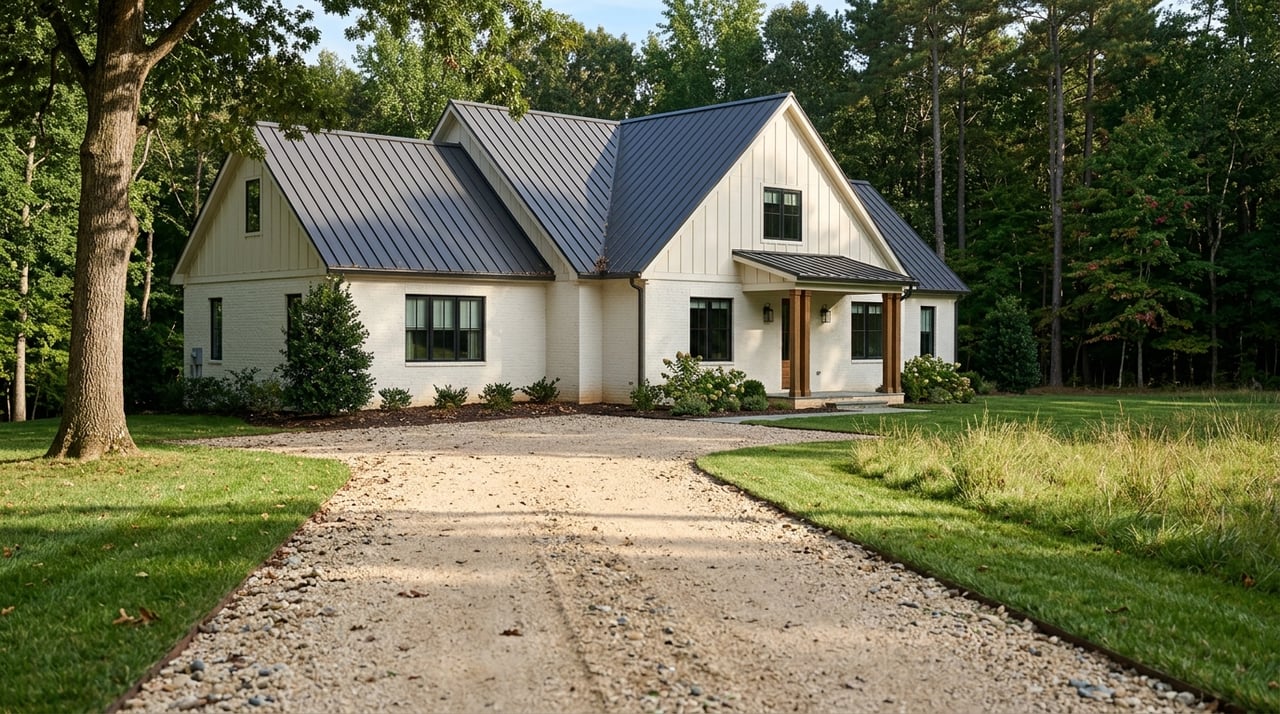
If you are used to subdivisions where home styles look fairly consistent, Powhatan can feel much broader. Recent examples in the market include modern farmhouse, ranch, colonial, craftsman, and historic farmhouse or estate-style properties. Many sit on 1 to 10 or more acres.
That variety can be a real advantage if you want something less standardized. It also means you should compare homes carefully, because age, layout, utility setup, and land use can vary much more from one property to the next than they often do in a suburban neighborhood.
The biggest daily-life change: commute
For many Midlothian buyers, the commute is the first adjustment they notice. A route estimate between Powhatan and Midlothian can be about 16 miles and 22 minutes in no-stop conditions, but that is not the whole story. Census QuickFacts estimates Powhatan residents have a mean travel time to work of 32.6 minutes.
Virginia Tech’s county profile also reports that many residents commute out toward Richmond, Henrico, or Chesterfield. So if you are moving for more space, it helps to weigh that benefit against the extra windshield time you may add to your week.
Test your real commute, not the map version
Before you buy, drive the route during the times you would actually travel. A quick online estimate can be helpful, but it may not reflect school traffic, work-hour congestion, or the distance from the main road to the house itself. A property with a Powhatan address can still feel very different depending on where it sits in the county.
Transportation in Powhatan is mostly road-based. The county notes that residents rely on the local transportation network, with roads maintained either by VDOT or privately. The county, GRTC, and DRPT are also rolling out LINK, an on-demand microtransit service with pickups at selected county destinations, but daily life for most households still centers on driving.
Utilities work differently in many areas
This is one of the most important changes to understand before moving from a subdivision to acreage. In many suburban neighborhoods, public water and sewer are expected. In Powhatan, utility service is more limited.
Powhatan County utilities currently serve only portions of the county along the Route 60 corridor to Flat Rock and the courthouse area. For many properties, especially those outside those service areas, buyers should expect private well and septic rather than public connections.
Ask detailed questions about well and septic
If a home is not on public water and sewer, do not treat that as a minor detail. Ask what permits are on file, what reports exist, and whether there is a documented reserve area for the septic system. These details matter not only for your daily use, but also for future improvements and long-term ownership.
The county also notes that new residential structure permits require a VDOT entrance permit or an approved existing entrance, along with a well-and-septic permit unless the lot is already served by public water and sewer. That is especially relevant if you are looking at land, a newer build, or a home where future additions may be part of your plan.
Rural living means more due diligence
In a subdivision, many of the practical details are already standardized. On acreage, the property itself often needs closer review. That does not mean you should avoid these homes. It just means your process should be more careful.
Before you move forward, ask targeted questions about the parcel, access, utilities, and future use. This is where local guidance matters most, because two properties with similar price points can come with very different ownership responsibilities.
Key questions to ask before you buy
- What zoning district is the parcel in?
- Is it a true 10-acre rural lot, part of a conservation subdivision, or something else?
- Is the home on public water and sewer, or private well and septic?
- If it has well and septic, what permits, reports, and reserve areas are documented?
- Has the driveway or entrance already been approved by VDOT?
- Who maintains the road or private drive?
- What does the commute look like during real rush-hour conditions?
- If you want to clear land, add structures, or make site changes later, what permits will be required?
Powhatan also requires a land-disturbance permit before disturbances of 10,000 square feet or more, with some county-listed exceptions. If your dream includes a barn, detached garage, expanded driveway, or site work, that is worth understanding early.
What the housing market looks like
Powhatan remains heavily oriented toward detached homes. The county’s comprehensive plan estimated the housing stock at 93.9% detached single-family, 2.0% attached, 3.1% mobile homes, and 1.0% multifamily. So if you are shopping here, detached housing is far and away the dominant option.
A January 2026 CVRMLS market update showed 67 homes for sale, 1.9 months of inventory, a median sales price of $575,000, and an average sales price of $626,856. For buyers moving from Midlothian, that context matters because land, home style, and utility setup can all influence value in ways that differ from a more uniform subdivision market.
Lifestyle trade-offs to expect
Most buyers do not move from Midlothian to Powhatan by accident. They are making a lifestyle trade. Usually, the goal is more land, more privacy, and a more rural feel.
The trade-off is that you may also get longer drives, more self-managed utilities, and more parcel-level due diligence before closing. For the right buyer, that trade feels absolutely worth it. The key is knowing that upfront so your expectations match the reality of ownership.
What stays convenient in Powhatan
Moving to acreage does not mean giving up every amenity. Powhatan County Parks & Recreation maintains multiple parks, trails, fields, and programs. Fighting Creek Park alone includes up to 2.5 miles of gravel walking paths and more than three miles of trails.
For households looking into school logistics, Powhatan County Public Schools states that all schools are accredited, and the transportation department operates 81 buses and 40 vehicles. Those practical systems can matter when you are comparing a rural move against the convenience of your current setup.
How to decide if the move fits you
If you love the structure and predictability of subdivision living, Powhatan may feel like a bigger adjustment than you expect. But if you want breathing room, quieter surroundings, and a property that gives you more separation from neighbors, the move can be a strong fit.
The best way to decide is to compare your current routine with the version of life you actually want. Think about your commute, utility comfort level, yard and land maintenance expectations, and how much privacy matters to you. When you line those factors up honestly, the right answer usually becomes clearer.
If you are weighing a move from Midlothian to Powhatan, the right guidance can help you sort through lot types, commute realities, utilities, and resale considerations with confidence. Reach out to Rick Cox Realty Group for practical, local help as you plan your next move.
FAQs
What is the biggest difference between Midlothian and Powhatan living?
- The biggest change is usually the trade between more land and privacy in Powhatan versus the easier commute patterns and more standardized utilities often found in Midlothian subdivisions.
What lot sizes are common for homes in Powhatan?
- Powhatan includes a range of lot sizes, with current examples from under 1 acre to 3 or more acres, plus larger parcels over 10 acres, and some zoning districts such as A-10 show a 10-acre minimum lot size.
What utility setup should buyers expect in Powhatan?
- Many Powhatan properties rely on private well and septic, because county utility service is limited to certain areas along the Route 60 corridor to Flat Rock and the courthouse area.
What should buyers ask about a Powhatan acreage property?
- Buyers should ask about zoning, lot classification, well and septic permits, reserve areas, VDOT entrance approval, road maintenance responsibility, commute timing, and any permits needed for future land disturbance or improvements.
What does the Powhatan housing market look like?
- Powhatan is an overwhelmingly detached single-family market, and a January 2026 CVRMLS update reported 67 homes for sale, 1.9 months of inventory, a median sales price of $575,000, and an average sales price of $626,856.
What home styles are common in Powhatan?
- Recent examples include modern farmhouse, ranch, colonial, craftsman, and historic farmhouse or estate-style homes, often on 1 to 10 or more acres.